
How Are Diapers Made?
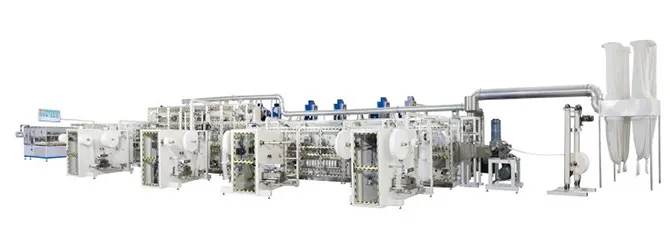
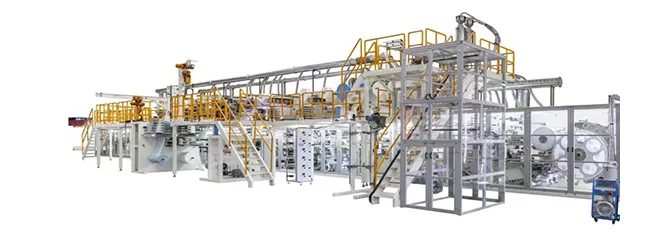
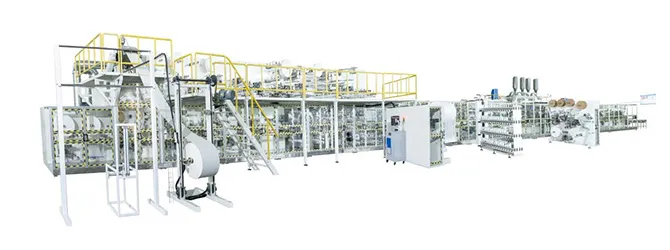
Disposable diapers are made by forming an absorbent core, combining it with a soft topsheet and a leak-resistant backsheet, adding elastics and fastening components, then cutting, folding and packing the finished products. Automated diaper production lines carry out these operations continuously, with inspections throughout the process.
The materials and assembly method vary between open diapers, pull-up pants and adult products. Most diaper factories process purchased fabrics, films, absorbent materials and other components rather than manufacture every raw material themselves.
What Materials Are Used to Make Diapers?
Each part of a disposable diaper performs a different job. The surface lets liquid pass through, the core absorbs and retains it, and the backsheet helps prevent it from reaching clothing.
| Diaper component | Common materials | Main function |
|---|---|---|
| Topsheet | Soft nonwoven fabric, often made with polypropylene or polyethylene fibers | Contacts the skin and allows liquid to pass toward the layers below |
| Acquisition and distribution layer, or ADL | Specially designed nonwoven materials | Receives liquid quickly and helps spread it toward the absorbent core |
| Absorbent core | Fluff pulp and superabsorbent polymer, or an engineered composite core | Absorbs and retains liquid |
| Core wrap | Tissue or nonwoven fabric | Helps contain absorbent material and maintain core integrity |
| Backsheet and outer cover | Liquid-resistant film, often combined with a soft nonwoven outer layer | Helps prevent liquid leakage through the outside |
| Leg cuffs, waistbands and side panels | Nonwoven materials and elastic strands or elastic laminates | Support fit and help limit leakage around openings |
| Fastening and bonding components | Hook tabs, landing zones and suitable adhesives | Secure an open diaper and hold its layers and components together |
Not every diaper contains exactly the same layers. A product may use a different liquid-distribution structure, a reduced-pulp core or a preformed absorbent composite.
What Makes a Diaper Absorb Liquid?
Superabsorbent polymer, or SAP, absorbs liquid and swells into a gel that helps retain it inside the core. Sodium polyacrylate is a commonly used SAP in disposable diapers.
In a traditional core, fluff pulp provides a fiber structure that helps receive and distribute liquid. SAP supplies much of the liquid-retention capability.
The layers above the core also matter. Liquid must pass through the topsheet and reach the absorbent material quickly enough. Adding more SAP alone does not guarantee faster absorption or better performance.
How Are Diapers Manufactured Step by Step?
A typical diaper manufacturing process includes the following operations. Some take place in parallel, and their exact order depends on the product design and machine configuration.
1. Prepare and Feed the Materials
Rolls of nonwoven fabric, backsheet film, core wrap and other web materials are loaded onto unwinding units. Elastics, fastening materials and adhesive are supplied to their respective processing stations.
Web guides keep moving materials aligned, while tension controls help prevent stretching, wrinkles and unstable feeding. On suitably equipped lines, automatic splicing connects a new roll as the previous one runs out.
This stage keeps the materials moving through the line in a controlled and coordinated way.
2. Form the Absorbent Core
For a fluff-pulp core, a mill separates pulp into fibers. A forming system uses controlled airflow and suction to deposit the fibers into the required shape while SAP is metered into the core.
The absorbent structure is wrapped and may be compressed to achieve the intended dimensions and density.
A machine designed for a preformed composite core may instead unwind, cut and position the supplied core material. It does not need to form the same pulp-and-SAP structure on the line.
3. Position the Layers and Bond Them Together
The core is combined with the topsheet, backsheet and any specified acquisition or distribution layer.
Adhesive is applied in controlled patterns to secure the components. Placement matters: the layers must remain aligned, and bonding must hold the product together without unnecessarily restricting softness or liquid movement.
A cloth-like outer cover may be laminated to the backsheet film before it reaches the diaper line or combined with it during production.
4. Add Elastics, Leak Guards and Fasteners
Elastic strands or laminates are incorporated into the leg, waist or side-panel areas under controlled stretch. Elasticated barrier cuffs are formed to help contain liquid around the legs.
Open diapers receive fastening tabs and a landing area so the waist can be opened, adjusted and secured.
Accurate placement and controlled elastic tension help the finished diaper fit consistently. Too much or too little stretch changes the shape and fit of the product.
5. Shape, Cut and Finish the Diaper
Rotary cutting units create the specified contours and separate the continuous material web into individual products. Trim is removed, and folding or component-positioning operations complete the required shape.
Pull-up pants also need their waist structure closed, commonly through a designed side-seam bonding process. Ultrasonic or thermal bonding may be used, depending on the materials and product construction.
Features such as core channels, embossing and wetness indicators require additional processes where specified. They are not present in every diaper.
6. Inspect the Products and Remove Defined Defects
Sensors and camera systems can monitor specified features, such as component presence, material alignment, tape position and product dimensions.
When the system identifies a tracked defect, a rejection mechanism removes the affected product. Inspection capability depends on the equipment and the defects it has been configured to detect.
Absorption, liquid retention and surface dryness require separate performance tests. A camera cannot establish these properties simply by checking the product's appearance.
7. Fold, Count and Package
Finished diapers are folded, counted and arranged into stacks. A packaging system compresses and inserts the stacks into bags, then seals the packs.
Coding equipment can apply batch or production information for traceability. Further equipment may place retail packs into shipping cartons.
The converting machine, stacker and bagger must operate together at compatible rates to avoid a downstream bottleneck.
How Does Manufacturing Affect Diaper Performance?
Diaper performance depends on material selection and how accurately those materials are processed and assembled. Two diapers with similar ingredients can perform differently.
Four production details are particularly important:
- Core consistency: Uneven pulp or SAP distribution can create areas with different absorption capacity.
- Layer alignment: The acquisition layer and core must be positioned to receive liquid in the intended area.
- Elastic and cuff construction: Placement, stretch and attachment influence fit and leakage around the legs and waist.
- Bonding quality: Layers and seams need to remain secure during use while retaining the required softness and flexibility.
A thicker diaper is not automatically more absorbent. Core design, absorbent-material distribution and liquid movement through the layers all influence the result.
How Is Diaper Quality Checked?
Quality control combines incoming-material checks, monitoring during production and testing of finished samples.
Typical checks include:
| Check | What it evaluates |
|---|---|
| Dimensions and component position | Whether the diaper matches its specified size and construction |
| Core weight and distribution | Whether absorbent material is supplied consistently |
| Liquid acquisition | How quickly liquid enters the absorbent structure under defined test conditions |
| Retention and rewet | How much liquid is retained and how much returns to the surface under a defined load |
| Seam, elastic and fastening strength | Whether important attachments withstand the specified forces |
Clean material handling, equipment cleaning and controlled storage also support manufacturing hygiene.
No single test describes the entire product. Absorption results should be considered alongside fit, leakage behavior and structural integrity.
Are Open Diapers and Pull-Up Pants Made the Same Way?
They share many material-handling and core-processing steps, but their waist construction and finishing operations differ.
| Feature | Open diapers | Pull-up pants |
|---|---|---|
| Waist fastening | Adjustable tabs and a landing area | A closed, elasticated waist |
| Elastic structure | Leg elastics, cuffs and selected waist or ear components | Elasticated waist panels or belts, plus leg and cuff structures |
| Finishing | Tab and ear placement, shaping and folding | Waist-panel handling, folding and side-seam formation |
| Production equipment | Configured for the specified open-diaper construction | Includes the handling and bonding processes required for pants |
A baby pull-up pants machine needs dedicated waist-panel handling and side-seam processes. Adult diaper machines use related manufacturing principles, with different dimensions, absorbent requirements and product-handling needs.
Frequently Asked Questions
Are Disposable Diapers Made of Cotton?
Most conventional disposable diapers rely on nonwoven fabrics, absorbent polymers and, in many designs, wood-derived fluff pulp rather than cotton. Some products include cotton in selected components. A soft, cloth-like surface does not necessarily mean the material is cotton.
Do All Diapers Contain Fluff Pulp?
No. Some diapers use reduced-pulp or fluff-free composite cores. These structures use engineered arrangements of SAP, carrier materials and bonding to manage liquid and maintain core integrity.
Why Can a Breathable Diaper Still Prevent Leaks?
A breathable backsheet can allow water vapor to pass while resisting liquid penetration under its intended conditions of use. Breathability and liquid resistance are different properties; the material and its construction determine both.
Are Diapers Sewn Together?
Disposable diapers are generally assembled using adhesives and selected bonding processes rather than sewing. Ultrasonic or thermal bonding can join suitable materials in areas such as pants side seams.
How Long Does It Take to Make One Diaper?
Diapers move through a continuous production line, so several products are being processed at different stations simultaneously. A line producing 600 diapers per minute delivers an average of 10 per second, but that does not mean each diaper travels through the entire machine in one-tenth of a second.
Can One Diaper Machine Produce Different Sizes?
Many lines can produce a defined range of sizes using adjustments, stored settings and specified change parts. The supported sizes depend on the platform, tooling and product construction. A size change is not always a software-only adjustment.