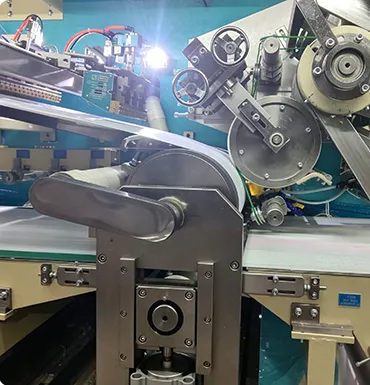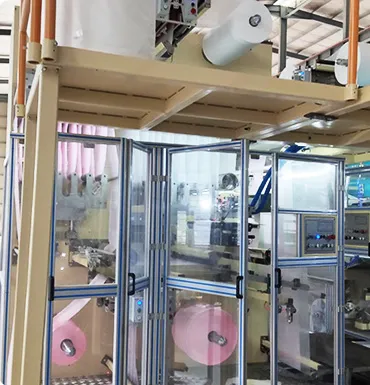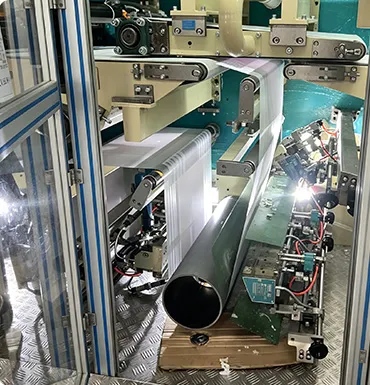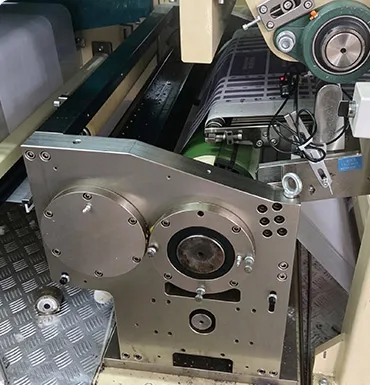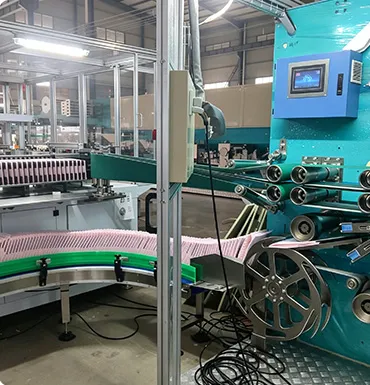

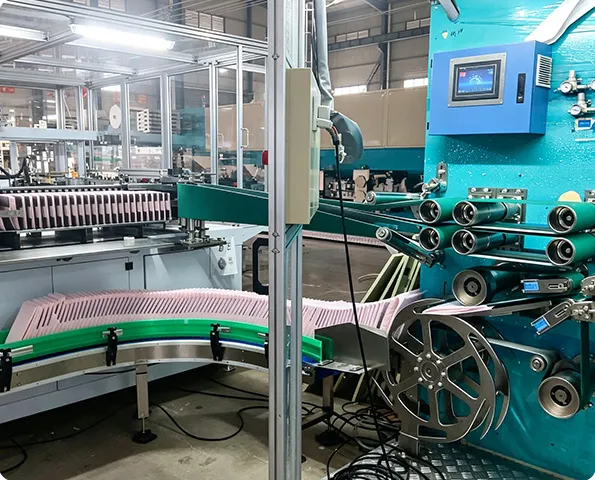
Complete Process Flow

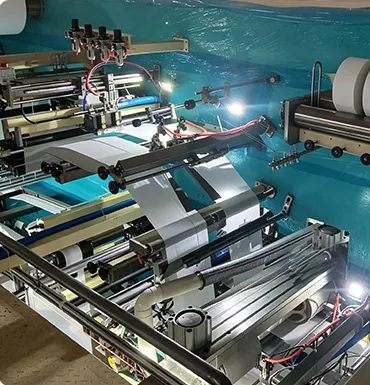
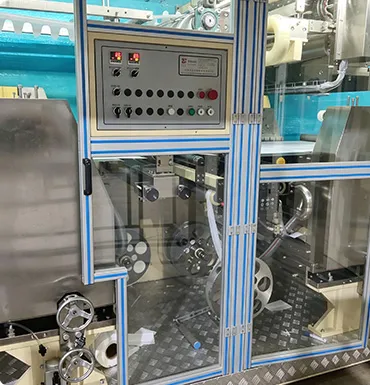
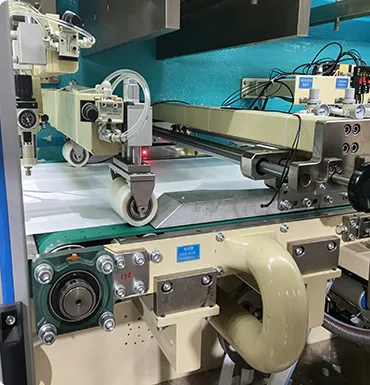
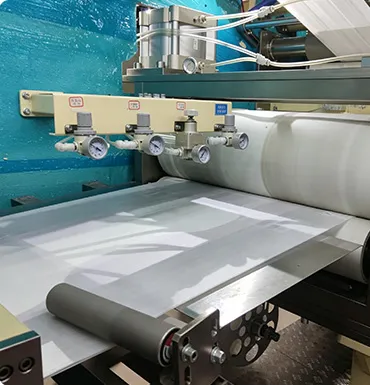
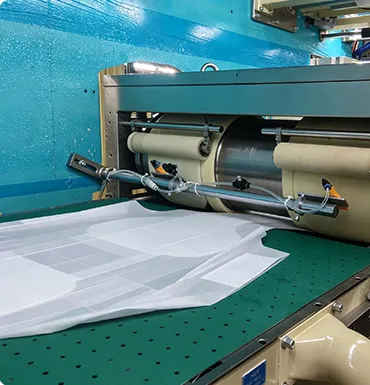
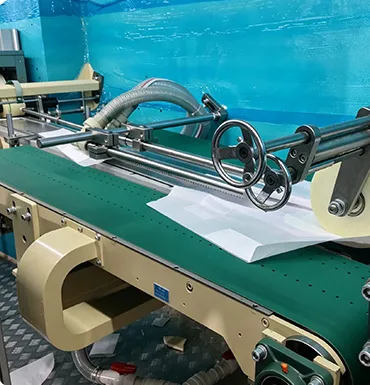
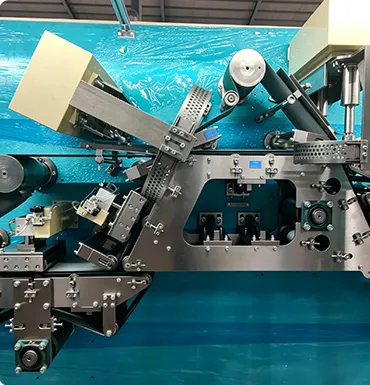
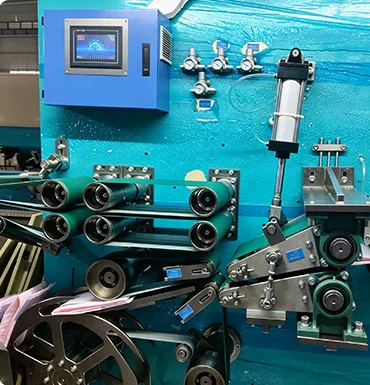
Covering every stage of the process, from the forming of the absorbent core and the assembly of the various layers to folding, counting, and the output of the finished product.

Stage A

Precision Absorbent Core Formation

forms pulp and SAP into a uniform, stable core to support consistent absorption.

InputMaterial feeding control
ProductionPrecise SAP distribution
OutputStable core shape
Material Feeding & Fiber Preparation
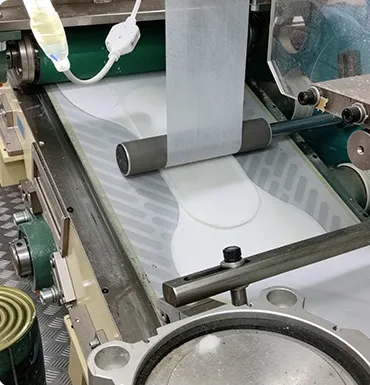
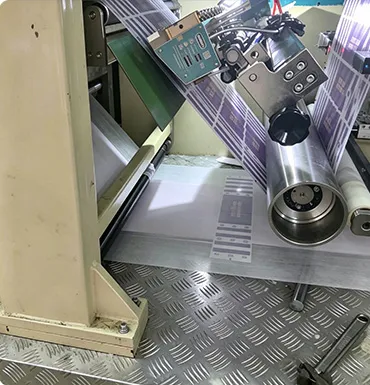
Top & Bottom Tissue Unwinding
Stage AStation 01 / 24

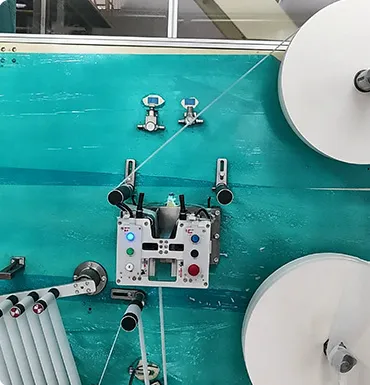
Top & Bottom Tissue Unwinding

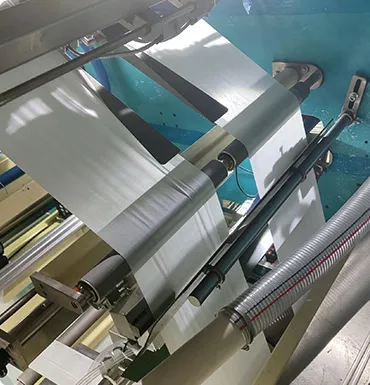
Continuous feeding of upper and lower tissue layers for absorbent core wrapping.

How it works

Zero-speed material splicing, dual swing-arm tension control, automatic web guiding and an early material-shortage alarm support stable feeding.

Why it matters

Helps maintain continuous production, stable web tension and consistent wrapping around the core.
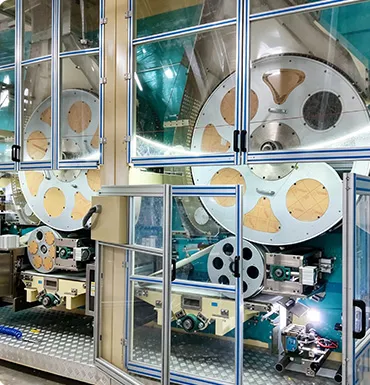
Fluff Pulp Crushing
Stage AStation 02 / 24

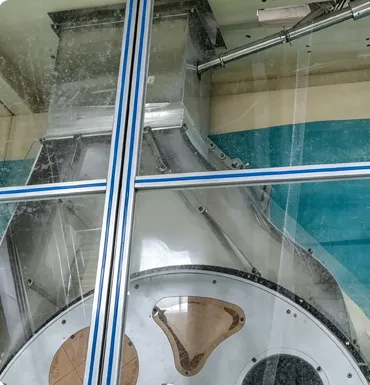
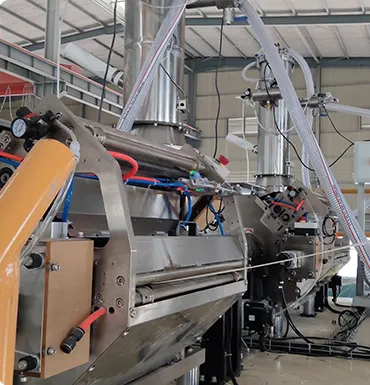
Fluff Pulp Crushing

Converts pulp rolls into loose fibers for absorbent core formation.

How it works

Electric loading and dual crushers use servo-controlled pulp feeding, with humidification, sound insulation and bearing-temperature monitoring.

Why it matters

Produces evenly opened fluff fibers for consistent core forming and efficient downstream processing.

Core Forming, Wrapping & Cutting
Dual-Mold Vacuum Core Forming
Stage AStation 03 / 24

Dual-Mold Vacuum Core Forming

Forms the large and small absorbent core layers through independent vacuum-assisted molding.

How it works

Independently adjustable vacuum zones, rotary material leveling and timed air cleaning help keep the mold drums and forming belts clear.

Why it matters

Supports uniform basis weight, accurate core geometry and controlled combination of the two core layers.

SAP Metering & Application
Stage AStation 04 / 24

SAP Metering & Application

Meters and distributes superabsorbent polymer into the fluff-pulp core.

How it works

Independent belt applicators use servo metering with adjustable layer distribution, plus low-material and blockage alarms.

Why it matters

Keeps SAP dosage and placement controlled to balance absorption performance with material use.

Full Core Tissue Wrapping
Stage AStation 05 / 24

Full Core Tissue Wrapping

Synchronizes the upper and lower tissue webs around the formed absorbent core.

How it works

Matched web speed and tension maintain full coverage and help prevent loose fiber or SAP leakage during transfer.

Why it matters

Protects core integrity and creates a stable structure for compaction and downstream lamination.

Core Compaction & Setting
Stage AStation 06 / 24

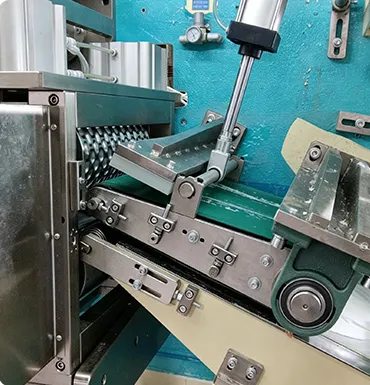
Core Compaction & Setting

Stabilizes core thickness, shape and internal material distribution.

How it works

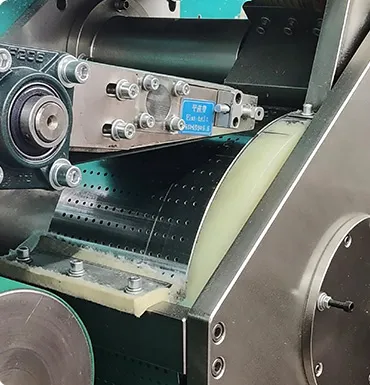
Cylinder pressure and temperature are adjustable, with smooth and mesh roller sets working together for controlled compaction.

Why it matters

Creates a more consistent core profile for reliable conveying, positioning and lamination.

Inline Absorbent Core Cutting
Stage AStation 07 / 24

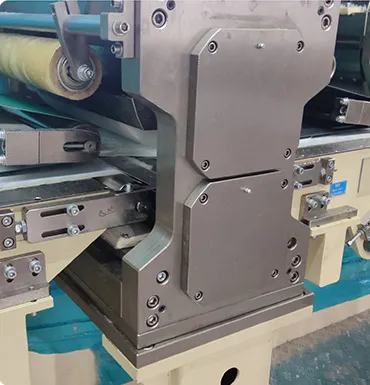
Inline Absorbent Core Cutting

Cuts the continuous core web into individual absorbent cores for the required diaper sizes.

How it works

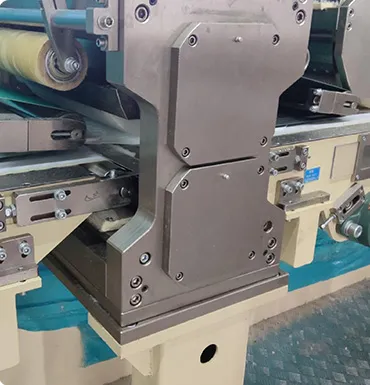
A carbide cutting unit supports M/L-compatible tooling, followed by vacuum transfer into the main assembly section.

Why it matters

Delivers consistent core length and accurate, stable transfer to the product assembly line.

Stage B

Multi-Layer Material Synchronization & Assembly

Each layer and component is accurately positioned and bonded to support a secure fit and reliable leak protection.

InputCore, nonwovens, film, elastics and tapes
OutputSealed individual diapers
Surface, Leak Guard & Backsheet Preparation
Leak Guard Nonwoven Unwinding
Stage BStation 08 / 24

Leak Guard Nonwoven Unwinding

Continuously feeds topsheet and side nonwoven materials into the standing leak-guard forming section.

How it works

Accumulator storage and dual-photoeye web guiding maintain alignment and reduce interruptions during material changes.

Why it matters

Provides stable material supply for consistent leak-guard formation and downstream lamination.

Standing Leak Guard Forming
Stage BStation 09 / 24

Standing Leak Guard Forming

Slits, folds and bonds nonwoven materials with elastic strands to form raised side leak guards.

How it works

Pneumatic center slitting, two servo-stretched elastics per side and controlled glue-and-heat bonding form the folded guard structure.

Why it matters

Creates upright side barriers that improve fit and help reduce side leakage.

ADL Cutting & Lamination
Stage BStation 10 / 24

ADL Cutting & Lamination

Cuts and positions the acquisition distribution layer between the topsheet and absorbent core.

How it works

Flat cutting and vacuum-assisted transfer place the ADL at the configured position on the inner topsheet.

Why it matters

Supports faster liquid acquisition and distribution while helping the topsheet feel drier.

Elastic Waistband Cutting & Lamination
Stage BStation 11 / 24

Elastic Waistband Cutting & Lamination

Cuts and integrates elastic waistband material into the diaper structure for controlled fit.

How it works

The shown configuration supports 150 mm and 170 mm materials, with flat cutting and detection for missing waistband pieces.

Why it matters

Adds controlled waist elasticity for closer fit, comfort and improved back-leak protection.

PE Film & Backsheet Nonwoven Lamination
Stage BStation 12 / 24

PE Film & Backsheet Nonwoven Lamination

Combines PE film and bottom nonwoven to form the breathable and protective backsheet structure.

How it works

Vertical material feeding, glue-and-heat lamination and three leg elastics per side are combined with elastic-break monitoring.

Why it matters

Creates the waterproof outer layer while the leg elastics support fit and side-leak control.

Core & Fastening Component Assembly
Centered Absorbent Core Lamination
Stage BStation 13 / 24

Centered Absorbent Core Lamination

Positions the prepared absorbent core accurately between the topsheet and backsheet assemblies.

How it works

Vacuum conveying controls core transfer and placement at the center of the product web.

Why it matters

Keeps the absorption zone aligned with the intended body-contact area.

Front Tape Photoeye Cutting
Stage BStation 14 / 24

Front Tape Photoeye Cutting

Uses print-mark positioning to cut front tape material to the required length.

How it works

Photoeye registration controls cutting, with an adjustable 120–130 mm cut length and a heated anti-stick bottom roller.

Why it matters

Improves front-tape size consistency, placement accuracy and finished-product appearance.

Front Tape Lamination & Setting
Stage BStation 15 / 24

Front Tape Lamination & Setting

Applies the cut front tape to the designated backsheet area and reinforces the bond.

How it works

Controlled adhesive application and a heated pressure roller secure the tape to the product web.

Why it matters

Builds a stable fastening surface designed to remain attached during repeated use.

PP Side Tape Cutting & Folding
Stage BStation 16 / 24

PP Side Tape Cutting & Folding

Cuts and folds the left and right fastening tapes before final positioning.

How it works

Carbide cutters provide an adjustable 25–50 mm cut length, with folding devices and manually adjustable cutter spacing.

Why it matters

Produces consistently sized, neatly folded side tapes that are easier for the user to handle.

Symmetrical Side Tape Lamination
Stage BStation 17 / 24

Symmetrical Side Tape Lamination

Laminates folded side tapes symmetrically onto both sides of the diaper.

How it works

Adhesive bonding is combined with sensors that detect missing or skewed side tapes.

Why it matters

Supports balanced appearance, secure fastening and repeatable tape placement.

Sealing, Contour Cutting & Final Separation
Four-Side Heat Sealing
Stage BStation 18 / 24

Four-Side Heat Sealing

Applies controlled heat and pressure around the product perimeter to secure the laminated structure.

How it works

Multiple heated rollers apply adjustable temperature and pressure around the product edges.

Why it matters

Strengthens layer bonding and helps prevent delamination or edge leakage.

M/L Leg-Contour R-Cutting
Stage BStation 19 / 24

M/L Leg-Contour R-Cutting

Trims side material to form the required leg-opening contour.

How it works

The shown line uses a T15 R-cutter, digital pressure display, non-stop trim removal and automatic piece counting.

Why it matters

Forms a clean leg contour and supports configured M/L tooling changes on the production line.

Final Product Cutting
Stage BStation 20 / 24

Final Product Cutting

Cross-cuts the continuous assembled web into individual finished diapers.

How it works

A carbide cutting unit combines high-speed transverse cutting with controlled registration and clean edge formation.

Why it matters

Separates complete products consistently with neat, low-burr cut edges.

Planning an Diaper Production Line?

Share your needs with DanE. We’ll recommend a suitable machine configuration and line layout, and you’re always welcome to visit our factory to see the equipment and process firsthand.

Discuss Your Line with DanE
Stage C

Finished Diaper Folding, Counting & Stacking

Each diaper is folded and inspected before output, helping maintain consistent finished-product quality.

InputCut individual diapers
OutputCounted stacks ready for packing
Folding & Defect Rejection
Longitudinal Servo Folding
Stage CStation 21 / 24

Longitudinal Servo Folding

Folds each individual diaper longitudinally using a servo-controlled folding blade.

How it works

Servo control allows the fold position and fold length to be adjusted for the configured product.

Why it matters

Creates compact, consistent folded pieces for counting, stacking and packaging.

Swing-Arm Batch Rejection
Stage CStation 22 / 24

Swing-Arm Batch Rejection

Collectively ejects products that have been marked as defective by upstream detection points.

How it works

The rejection unit can be configured for two- or three-piece batch removal using a swing arm and air-blow discharge.

Why it matters

Separates marked defects without disrupting the flow of accepted products.

Folding & Defect Rejection
90° Turning, Counting & Conveying
Stage CStation 23 / 24

90° Turning, Counting & Conveying

Turns accepted folded products by 90 degrees, conveys them under vacuum and counts them automatically.

How it works

The shown configuration uses a 2 m vacuum-wheel conveyor, 10-piece counting and online phase adjustment at the discharge end.

Why it matters

Maintains an orderly product flow and prepares consistent groups for the next packing step.

Dual-Channel Stacking Output
Stage CStation 24 / 24

Dual-Channel Stacking Output

Directs products to either an automatic stacking channel or a manual bagging channel.

How it works

One channel reserves an interface for downstream packaging equipment, while the second provides a manual bagging station.

Why it matters

Allows the output section to match different automation levels and packing arrangements.

Process Control Throughout the Line

Quality is Built into Every Stage

At DanE, quality is managed throughout the production line, not checked only at the final output. Five key control points help maintain stable processing and consistent finished diapers.

01
Material Feeding & Web Control

Controlled tension, web guiding and material accumulation keep nonwovens, film, tissue and elastics feeding smoothly.

02
Absorbent Core Forming

Vacuum forming, pulp distribution, SAP metering and compaction help maintain a uniform, stable absorbent core.

03
Component Positioning

Photoelectric sensors, vacuum transfer and synchronized drives keep cores, ADL, tapes and other components correctly aligned.

04
Lamination, Sealing & Cutting

Controlled pressure, temperature and cutting registration help maintain secure bonding and consistent diaper dimensions.

05
Inspection & Output Control

Defects are detected for rejection, while accepted diapers are turned, counted and stacked for downstream packing.

FREQUENTLY ASKED QUESTIONS

Questions About Diaper Production Lines

Find answers to common questions about diaper production lines. For other requirements, please contact the DanE team.

Is every diaper production line made up of the same 24 stations?
-+
No. The page shows one complete configuration. The final number and arrangement of stations can change with product structure, size range, detection requirements, output target and packing method.
Which materials enter the production line?
-+
The line handles top and bottom tissue, fluff pulp, SAP, nonwovens for topsheet, backsheets and leak guards, PE film, ADL, elastic waistband, front tapes and side tapes. Material widths, basis weights and supplier specifications are confirmed during configuration.
Does the output section include a complete packing machine?
-+
Stage C covers folding, defect rejection, turning, counting and stacking through Station 24. A complete packing system is configured separately according to your bagging, bundling or carton packing requirements.
Which parameters should be confirmed before configuring the line?
-+
Confirm diaper structure, size range, target output, raw-material specifications, detection and rejection requirements, and your preferred packing method. These parameters determine the final station count, machine speeds and optional modules.
Can the same line produce different diaper sizes?
-+
One line can support multiple sizes within a defined range when the correct format parts, cutting settings and process recipes are configured. Very different product structures may require additional modules or a dedicated configuration review.

Get a Quote & Technical Support

Contact us to discuss your product, capacity, and machinery requirements. Our team will help you plan the right production solution.

Contact DanE Team
Contact DanE Team
FAQ
FAQ
01
Can you help us plan a new hygiene product factory?
You can work with our team on equipment selection, production capacity, factory layout, and project cost analysis, including raw materials, labor, and operating expenses.
02
Can you upgrade our existing production line instead of replacing it?
Certainly! We can assess which parts can be modified or upgraded while providing solutions compatible with your existing production line.
03
Can we visit your factory and inspect the equipment?
You can arrange a factory visit to review our manufacturing and assembly processes. Equipment testing and acceptance criteria can also be agreed upon for your project before delivery.

GET A QUOTE

COST CALCULATOR

183 6878 7879

183 6878 7879

sale01@dane-machinery.com